


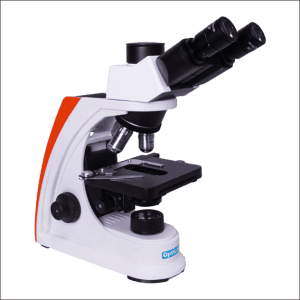
A microscope is an optical instrument used to produce an enlarged image of a specimen so that structures that cannot be observed directly can be studied more clearly. In laboratory use, a microscope’s capabilities are determined not only by its magnification but also by its optical system, focusing mechanism, illumination, and the configuration of its components.
Because the needs of each laboratory can vary, a microscope must be configured to support a wide range of observation activities. This is particularly important in educational and research settings, hospitals, and laboratories that use microscopes on a regular basis.
Getting to Know the Optilab IRIS-4
The OptiLab IRIS-4 is a biological microscope designed for observing specimens in routine work and research applications. The product manual specifies its use for observing living cells and specimens taken from tissues, with applications such as genetics, human blood and tissue analysis, neurology, pharmacology, and cell biology.
The OptiLab IRIS-4 is available with either a binocular or a Siedentopf trinocular head. These options allow institutions to customize the microscope’s configuration based on their needs for direct observation or documentation using a camera.
Advantages of the OptiLab IRIS-4
Plan Infinity Optical System for More Uniform Images
The optical system is one of the key components that determine image quality in a microscope. The OptiLab IRIS-4 uses a Plan Infinity objective designed to produce sharp, clear images all the way to the edges of the field of view. Thanks to these characteristics, the observed specimen area appears more uniform, allowing for better observation of details both in the center and in areas near the edges of the field of view.
The OptiLab IRIS-4 comes with four objective lens options: 4X, 10X, 40X (Spring), and 100X/1.25 Oil (Spring). Each objective lens has different Numerical Aperture (N.A.) and field of view characteristics, allowing users to select the objective lens that best suits their magnification level and observation needs.
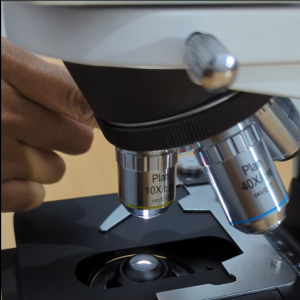
With this combination, the IRIS-4 not only offers a wide range of magnification options but also provides flexibility in determining how large an area of the specimen to observe and how much detail to magnify in specific sections. The 4X and 10X objectives can be used when the user needs a wider field of view, while the 40X and 100X oil-immersion objectives are available when observations require higher magnification.
As a result, the Plan Infinity system on the IRIS-4 offers a combination of image quality and magnification flexibility that can support a wide range of observation needs in the laboratory.
Magnification up to 1000X
With the WF 10X/20 mm eyepiece and the available objective options, the OptiLab IRIS-4 offers a total magnification range of 40X to 1000X.
This range allows users to adjust the magnification according to their observation needs. Observations can begin using a lower-magnification objective to obtain a broader view of the specimen area. Subsequently, a higher-magnification objective can be used when observation of finer details is required.
For the 100X/1.25 Oil objective, immersion oil must be used in accordance with the operating procedures. Therefore, high magnification should still be used while taking into account the procedures and the condition of the specimen.
3-Watt LED Lighting with Adjustable Brightness
The OptiLab IRIS-4 uses a 3-watt LED lamp as its light source. The lighting system is equipped with a brightness control in the form of a potentiometer that also functions as a switch.
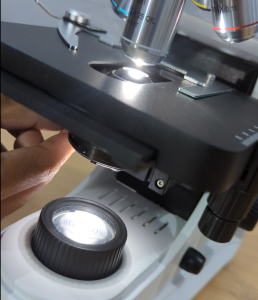
Users can turn on the light and then adjust the brightness level according to their observation needs. With the intensity control, the lighting level does not have to remain the same for every observation condition.
In addition, the LED system is part of a lighting configuration that can be used in conjunction with the backup battery system on the IRIS-4.
3000 mAh Lithium Battery as a Backup Power Source
One of the features that adds value to the OptiLab IRIS-4 is its battery backup system, which uses a 3000 mAh lithium battery. The system is equipped with a charging indicator and a battery level indicator to help users monitor the battery status.
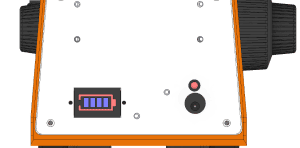
When the main power source is unavailable, the battery can be used and will last approximately ±3 hours at full brightness. The operating time can be extended by reducing the microscope’s light intensity.
This feature provides additional flexibility for laboratories that need to continue their observations during a power outage. Thanks to the backup battery system, the microscope’s lighting can remain on as long as the battery has power.
Can Still Be Used Even If the Battery Is Dead
The presence of a backup battery means the device isn't entirely dependent on the battery's condition.
The OptiLab IRIS-4 can still be used even if the battery is not working or cannot be charged. Battery replacement is also optional, depending on the user's needs.
This provides flexibility for long-term use. If the battery experiences a decrease in capacity or becomes damaged, the microscope can still be used with an adapter in accordance with the operating procedures.
In other words, the battery in the IRIS-4 serves as a backup power source, not the sole power source that determines whether the microscope can be used.
A Microscope Light Can Be Powered Using a 5-Volt Power Bank
In addition to the internal battery, the OptiLab IRIS-4 offers an alternative power source for its lighting system. The manual specifically states that the microscope lamp can be powered using a 5-volt power bank.
This support provides additional flexibility for microscope lighting when a specific power source is required. This feature complements the internal lithium battery, which serves as a backup system, giving the IRIS-4 multiple power options to support its lighting.
OptiLab IRIS-4 Specifications
In addition to features that support everyday use, technical specifications are an important factor to consider when institutions select a microscope. Here are the main specifications of the OptiLab IRIS-4:
| Komponen | Spesifikasi |
|---|---|
| Eyepiece | WF 10X/20 mm |
| Objective | Infinity Plan Objective 4X, 10X, 40X (Spring), 100X/1.25 Oil (Spring) |
| Total Magnification | 40X–1000X |
| Head | Binokuler atau Trinokuler Siedentopf |
| Inklinasi Head | 30° |
| Rotasi Head | 360° |
| Interpupillary Distance | 48–75 mm |
| Focus Adjustment | ±5 |
| Nosepiece | Quadplex |
| Stage Size | 145 × 140 mm |
| Stage Travel | 76 × 52 mm |
| Focusing System | Coaxial coarse & fine adjustment |
| Coarse Focus Travel | 26 mm |
| Fine Focus Precision | 2 μm |
| Condenser | Abbe, N.A. 1.25, adjustable aperture |
| Illumination | 3W LED |
| Battery | Lithium 3000 mAh |
| Battery Backup | About 3 hours at full brightness |
| Power Supply | 220V AC to 5V 2A DC Adapter |
| Local Content Requirement (TKDN) | Certified |
Should You Choose Binocular or Trinocular on the OptiLab IRIS-4?
The OptiLab IRIS-4 is available in both binocular and trinocular head configurations, allowing the setup to be customized to suit specific application needs. The main difference between the two becomes apparent when the microscope is used with a camera for documentation, demonstrations, or visualization of observation results.
[See also: OptiLab IRIS-4 Binocular vs. Trinocular: Which One Is Right for the Lab?]
If you are still considering the most suitable configuration, learn about the differences between the OptiLab IRIS-4 binocular and trinocular models, including camera usage in each configuration and the conditions under which each is best suited for laboratory use.
OptiLab IRIS-4 Has Met the TKDN Requirements
In addition to considering features and technical specifications, procurement considerations can also be an important factor for institutions in Indonesia. OptiLab IRIS-4 meets TKDN (Domestic Component Content) requirements, making it a valuable option for institutions that prioritize the use of domestically produced products when procuring laboratory equipment.
For universities, hospitals, laboratories, and other institutions, compliance with TKDN requirements can be one factor to consider when determining which equipment best meets their procurement needs.
Interested in learning more about OptiLab IRIS-4? Visit our product page to view the complete specifications and features of the microscopes offered.***