


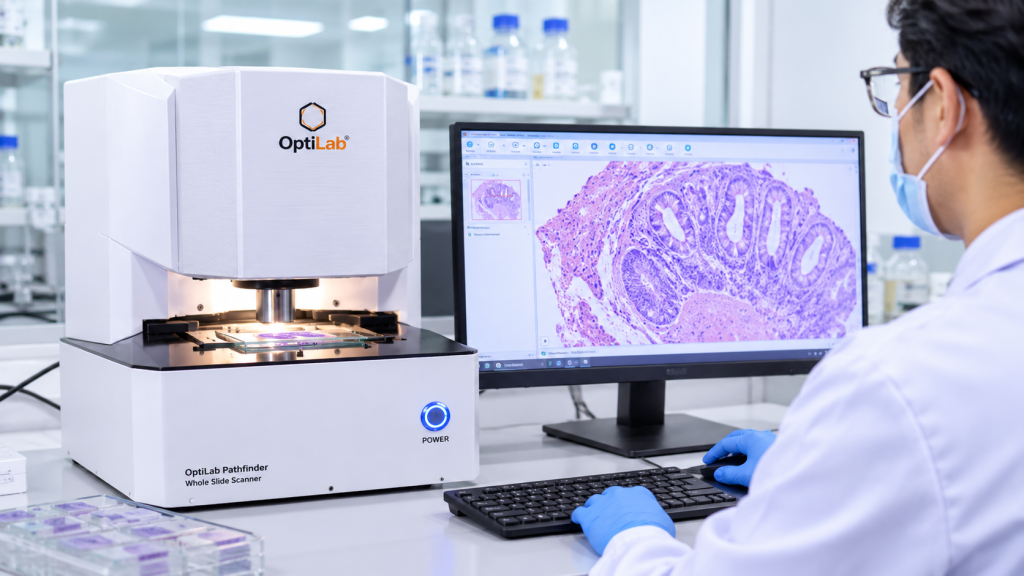
In the modern medical field, diagnostic speed and accuracy are absolute necessities. Previously, analysts had to view samples through a microscope eyepiece one by one. However, this method is time-consuming. Therefore, laboratories are now transitioning toward the digital pathology era using a whole slide scanner. As a result, the medical evaluation process becomes much more efficient.
Why Is Digital Pathology So Necessary?
Basically, physical glass slides have many drawbacks. First, these specimens are fragile and prone to fading over time. Furthermore, glass slides are very difficult to ship if doctors require remote consultations(telepathology).
Due to these limitations, digitization technology has become the best solution. Next, automated scanning instruments can convert physical slides into a single massive image file . In fact, this digital image has a resolution just as sharp as direct observation under a microscope.
How a Whole Slide Scanner Works in the Laboratory
Technically, this device works by sequentially scanning the slide from end to end. Then, the softwarestitchesthousands of these small images together into one complete, unified image. Consequently, analysts do not just view a single field of view, but rather the entire specimen.
In conclusion, the whole slide scanner innovation truly revolutionizes how modern pathology operates. For example, researchers can now zoom in on images on a computer monitor just like using Google Maps.
Scanning Solutions from PT Miconos
Every hospital and research center certainly needs reliable documentation equipment. Therefore, PT Miconos offers the OptiLab Microstepper product line to support your facility's digital transformation. Is your laboratory ready to step into the digital pathology era? Immediately visit our website at www.miconos.co.id or contact a PT Miconos representative via WhatsApp for further consultation!